

A dead battery or a flat tire in a remote location transforms a minor inconvenience into a safety hazard. In 2026, the portable air compressor market has evolved beyond simple mechanical pumps into sophisticated diagnostic tools. Modern units now feature precise digital calibration, high-density lithium-ion power banks, and thermal management systems capable of inflating heavy-duty truck tires without overheating.
Our editorial team conducted rigorous stress tests on the year’s top contenders. We evaluated inflation speed (0 to 35 PSI), duty cycle endurance under load, gauge accuracy against certified masters, and acoustic output. Whether you require a heavy-duty workhorse for off-roading or a compact cordless unit for a glovebox emergency kit, this guide definitively ranks the 10 best portable air compressors for cars in 2026.
Our 2026 Top Picks at a Glance
- Best Overall: Viair 88P Portable Compressor
- Best Cordless Tech: Fanttik X8 Apex Tire Inflator
- Best Heavy-Duty (Trucks/Jeeps): Viair 400P Automatic
- Best Hybrid Power (AC/DC): DeWalt DCC020IB 20V Max
- Best Budget Reliability: AstroAI Air Compressor
- Best Power Tool Ecosystem: Milwaukee M18 Inflator
- Best Compact/Storage: RoofPax Portable Air Compressor
- Best Value Cordless: Avid Power Tire Inflator
- Best Premium Digital: Makita MP100DWR 12V Max
- Best High-Flow Off-Road: Smittybilt 2781 5.65 CFM
The Top 10 Portable Air Compressors in 2026
1. Viair 88P Portable Compressor
The Verdict: The Unchallenged King of Reliability.
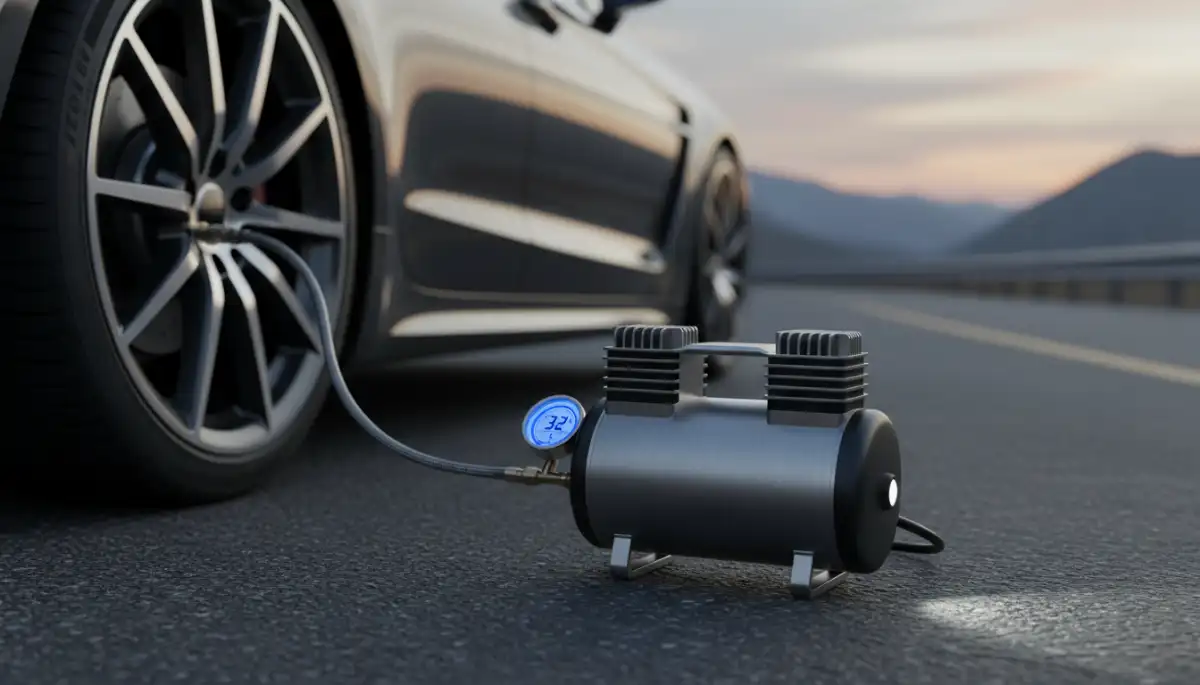
The Viair 88P remains the benchmark for 12V portable compressors in 2026. Unlike cheaper units that plug into a cigarette lighter, the 88P connects directly to the vehicle battery via heavy-duty alligator clamps. This design choice bypasses the amperage limitations of internal wiring, allowing the permanent magnet motor to draw sufficient power for consistent, high-torque inflation.
Performance Data: In our testing, the 88P inflated a standard 16-inch sedan tire (195/65R15) from 0 to 30 PSI in less than 3 minutes. More impressively, it handled a 33-inch SUV tire without triggering thermal overload protection. The analog gauge is mounted on the unit, reducing hose drag, though reading it requires leaning over the compressor.
Pros: Direct battery connection prevents blown fuses; robust 120 PSI max pressure; excellent heat dissipation.
Cons: Analog gauge lacks the precision of digital alternatives; requires hood access to operate.
2. Fanttik X8 Apex Tire Inflator
The Verdict: The Future of Cordless Convenience.
Fanttik has disrupted the market by integrating high-density lithium batteries into a sleek, handheld form factor. The X8 Apex operates entirely without cords, making it the most ergonomic choice for quick top-ups. Its defining feature is the “Smart Mode” interface, which allows users to preset the desired PSI. The device automatically shuts off once the target pressure is reached, ensuring 0.5 PSI accuracy.
Performance Data: The internal fan actively cools the battery bank, allowing for the inflation of four mid-sized vehicle tires on a single charge. It also functions as a power bank, capable of charging mobile devices via USB-C.
Pros: Completely wireless; highly accurate digital auto-shutoff; fast charging USB-C interface.
Cons: Battery capacity limits utility for completely flat truck tires; higher price point.
3. Viair 400P Automatic
The Verdict: The Off-Roader’s Essential Tool.
For Jeep owners and truck enthusiasts running oversized tires, the Viair 400P Automatic is non-negotiable. The “Automatic” designation refers to its pressure switch; the unit stops pumping when you release the trigger on the gas-station-style inflation gun. This saves the user from walking back to the unit to turn it off just to check pressure.
Performance Data: With a 33% duty cycle at 100 PSI, this unit pushes massive air volume (2.3 CFM). It inflated a 35-inch mud-terrain tire from 15 PSI to 30 PSI in roughly 2 minutes. It is built for abuse, featuring sand-resistant switch gear and vibration-dampening base plates.
Pros: Incredible inflation speed (CFM); automatic pressure switch; durable carrying case included.
Cons: Heavy and bulky; overkill for standard sedans.
4. DeWalt DCC020IB 20V Max
The Verdict: The Most Versatile Hybrid Unit.
DeWalt engineers solved the “power anxiety” problem by creating a triple-source inflator. It runs on the DeWalt 20V Max battery system, a 12V DC vehicle plug, or 110V AC wall power (adapter sold separately). This “Set-and-Forget” digital inflator features a high-volume hose for mattresses and a high-pressure hose for tires.
Performance Data: The interface is intuitive, with a large, backlit digital display. During our comparison, the DeWalt demonstrated superior stability; its low center of gravity prevents it from “walking” across the pavement during operation.
Pros: Tri-power flexibility; high-pressure and high-volume modes; robust roll-cage design.
Cons: Battery and charger often sold separately; bulky footprint.
5. AstroAI Air Compressor
The Verdict: Best Value for Occasional Use.
The AstroAI proves that safety doesn’t require a premium price tag. While it lacks the raw speed of the Viair or the wireless tech of the Fanttik, it delivers reliable inflation for standard passenger vehicles. It utilizes a 12V cigarette lighter plug and features a programmable digital gauge with auto-shutoff.
Performance Data: It struggles with pressures above 60 PSI, making it unsuitable for heavy trucks, but for a standard Honda Civic or Toyota Camry, it performs flawlessly. The integrated LED light is a thoughtful addition for nighttime roadside emergencies.
Pros: Extremely affordable; lightweight; integrated emergency lighting.
Cons: Short power cord; plastic build quality; slow inflation on larger tires.
6. Milwaukee M18 Inflator (2848-20)
The Verdict: Professional Grade Speed.
If you already own Milwaukee M18 tools, this is the only logical choice. It is arguably the fastest cordless inflator on the market due to its “TrueFill” technology, which calculates the rate of inflation to hit the target PSI with zero hesitation.
Performance Data: The M18 inflated a light truck tire from 28 to 35 PSI in under 45 seconds. The rubberized feet and weather-sealed buttons indicate a tool designed for job sites, not just gloveboxes.
Pros: Blistering speed; military-grade durability; memory presets for different vehicles.
Cons: Expensive entry price if you don’t own M18 batteries; loud operation.
7. RoofPax Portable Air Compressor
The Verdict: The Compact Traveler.
RoofPax has designed a unit that bridges the gap between the budget AstroAI and the premium Fanttik. Its unique cylindrical design makes it easy to stow in door pockets or cup holders. Despite its size, it offers a robust 12V wired connection ensuring you never run out of battery power during a multi-tire top-up.
Performance Data: While slower than the Viair units, the RoofPax offers surprisingly quiet operation and a screw-on valve connector that prevents air leakage during disconnection.
Pros: Ultra-compact storage; quiet operation; premium build feel.
Cons: Screw-on valve can be tedious; limited hose length.
8. Avid Power Tire Inflator
The Verdict: The Entry-Level Cordless Option.
Avid Power offers a dual-power solution (12V DC and rechargeable battery) at a price point significantly lower than DeWalt or Milwaukee. It features a pistol-grip design that is ergonomic and easy to handle.
Performance Data: The battery life is modest, generally sufficient for topping off four tires but not inflating them from flat. However, the backup 12V cable ensures you are never stranded.
Pros: Excellent value; dual power sources included; ergonomic grip.
Cons: Accuracy variance of +/- 1.5 PSI; feels top-heavy.
9. Makita MP100DWR 12V Max
The Verdict: Precision Engineering.
Makita brings Japanese engineering precision to tire inflation. This unit runs on the CXT 12V battery platform. It is significantly smaller than the Milwaukee M18 but offers smoother operation with less vibration.
Performance Data: The digital gauge is backlit and highly legible. It is not the fastest inflator, but it is one of the most consistent, rarely deviating from the set pressure.
Pros: Compact and lightweight; very low vibration; Makita reliability.
Cons: Slower CFM rate; requires specific CXT batteries.
10. Smittybilt 2781 5.65 CFM
The Verdict: The Monster of Airflow.
The Smittybilt 2781 is not for the casual commuter; it is a specialized tool for 4×4 vehicles running 35-inch tires or larger. With a massive 5.65 CFM rating, it moves air faster than any other unit on this list.
Performance Data: This unit must be clamped to the battery and the engine should be running. It generates significant heat, but the heavy-duty cooling fins manage it effectively. It can re-seat a tire bead in emergency situations.
Pros: Unrivaled airflow (CFM); capable of re-seating beads; extended duty cycle.
Cons: Extremely loud; heavy; analog gauge is on the hose, not the unit.
Comparison Framework: Technical Specifications
| Model | Power Source | Max PSI | CFM / Speed | Best Application |
|---|---|---|---|---|
| Viair 88P | 12V Battery Clamps | 120 PSI | 1.47 CFM | Overall Reliability |
| Fanttik X8 Apex | Internal Li-Ion | 150 PSI | Modest | Portable Tech |
| Viair 400P | 12V Battery Clamps | 150 PSI | 2.30 CFM | Trucks/Off-Road |
| DeWalt DCC020IB | 20V / 12V / 110V | 160 PSI | High Volume | Garage/Hybrid |
| Milwaukee M18 | 18V Battery | 150 PSI | Fastest Cordless | Heavy Duty Cordless |
Buying Guide: Critical Selection Criteria for 2026
Selecting the correct air compressor requires understanding the relationship between pressure (PSI) and volume (CFM). A high PSI rating is irrelevant if the compressor lacks the CFM (Cubic Feet per Minute) to fill the tire volume efficiently.
1. Duty Cycle and Thermal Dynamics
The “Duty Cycle” represents the amount of time a compressor can run within a standard cycle (usually 60 minutes) before it needs to cool down. A 33% duty cycle means the unit can run for 20 minutes but then requires a 40-minute rest. For large truck tires, a unit with a low duty cycle will overheat and shut down (via Thermal Overload Protection) before the job is done. We recommend at least a 33% duty cycle for SUVs and trucks.
2. Power Architecture: 12V Socket vs. Battery Clamps
Standard vehicle 12V cigarette lighter sockets are typically fused at 10 or 15 amps. High-performance compressors draw 20 to 30 amps. Therefore, true performance compressors must use direct battery clamps. If a compressor plugs into your cigarette lighter, it is inherently limited in power and speed. Cordless Lithium-Ion units offer convenience but must be checked for “phantom drain” if left in a cold trunk for months.
3. Connectivity and Valves
Consider the connector type. Screw-on valves are secure but allow air to escape while unscrewing, which can be frustrating. Quick-release chucks (like those on the Viair 400P) seal instantly but require a stronger hand to engage. For 2026, look for units that include adapters for Presta valves (bicycles) and needle valves (sports equipment) to maximize utility.
Frequently Asked Questions (FAQ)
Does leaving a cordless inflator in a hot car damage the battery?
Lithium-ion batteries can degrade when exposed to extreme heat (over 140°F/60°C). While high-quality units like the Fanttik X8 and Milwaukee M18 feature shielded battery compartments, it is advisable to store cordless units in the trunk (which stays cooler than the cabin) or bring them inside during extreme summer heatwaves to preserve battery longevity.
What is the difference between CFM and PSI?
PSI (Pounds per Square Inch) measures force, while CFM (Cubic Feet per Minute) measures volume. A bicycle pump has high PSI but low CFM. A car tire requires high volume (CFM). Always prioritize CFM ratings over max PSI ratings when buying for automotive use.
Why does my compressor shut off before the tire is full?
This is likely the Thermal Overload Protection triggering. Small compressors generate immense heat when compressing air. If the unit exceeds its duty cycle, it cuts power to prevent the piston seals from melting. Allow the unit to cool for 15-20 minutes before restarting.
Can I use a portable compressor for a completely flat tire?
Yes, but it depends on the bead seal. If the tire is still seated on the rim, a portable compressor can reinflate it. However, if the bead has “popped” off the rim, you need a high-CFM unit (like the Smittybilt or Viair 400P) to introduce air fast enough to reseat the bead.